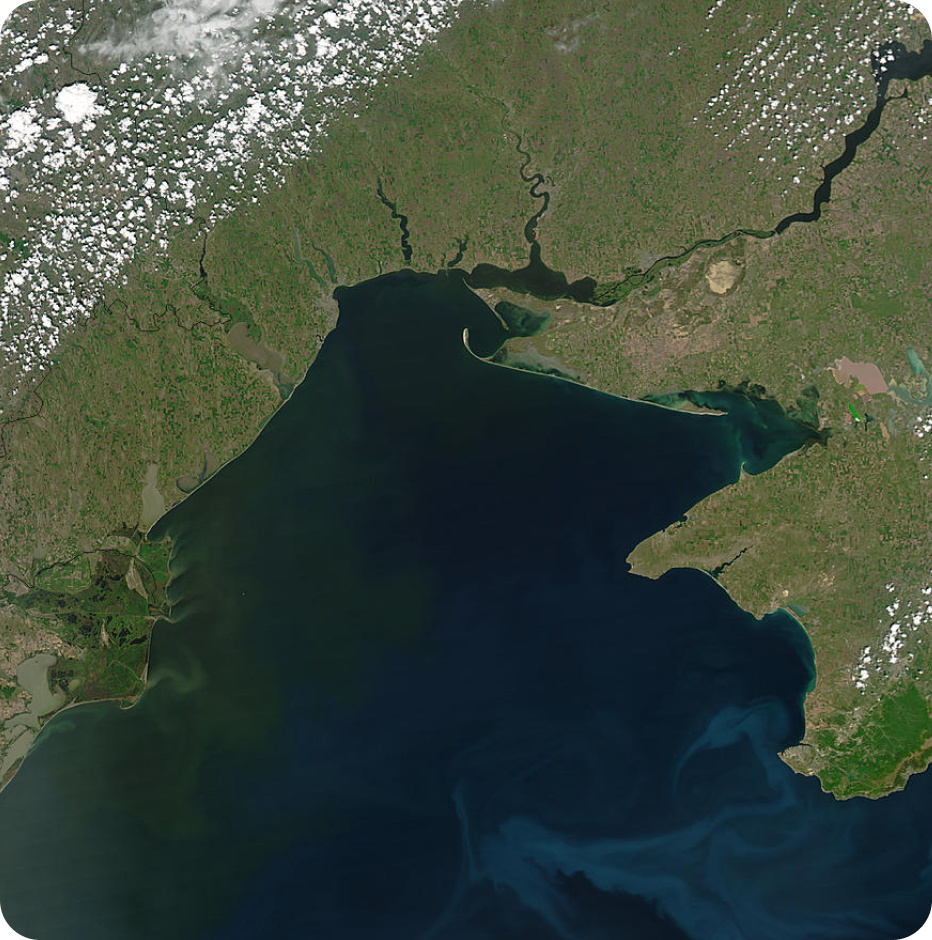
Green Hydrogen and Ammonia South Transport Hub of Ukraine

Our main goal is to build a green hydrogen and ammonia production and storage hub empowered by renewable energy sources such as solar and wind. We aim to decentralise, diversify, and decarbonise Ukraine’s energy system.
Contact Us

How do we plan to achieve it?

Building an Ammonia-Hydrogen Production & Bunkering Plant

Shipping accounts for 18-30% of the world’s nitrogen and 8% of its sulfur emissions, highlighting the need for a paradigm shift in transportation through alternative fuels. Therefore, Green ammonia emerges as a formidable alternative, with its market projected to skyrocket from USD 0.3 billion in 2022 to USD 70.19 billion by 2032.

Main Infrastructure Stakeholders
South Transport Hub and Odessa Port Plant
Location:
Odesa region, Ukraine
Land plot:
Expected area of construction is 37,5 Ha

Enhancing Energy Systems through Innovation

In the era of Just Transition, Ukraine became the Go-to-region for the EU to meet its Co2-emissions reduction goals by 2030. Due to its abundant resources Ukraine positions itself as hub for development of renewable energy, hydrogen and low-carbon technologies supporting energy mix diversification objectives of the EU.

Therefore, we are establishing a large-scale green ammonia and hydrogen production export hub, designed to prove commercial viability and attract investment for Financial Investment Decision (FID) readiness. As part of the initial development we expect to generate comprehensive design and feasibility studies for solar and wind farms, hydrogen and ammonia production, and port infrastructure, including 12 months of on-site wind resource measurement to underpin the project foundation.

Leveraging the South Transport Hub strategic location allowing us to capitalize on proximity to an existing ammonia and high-pressure pipelines and develop port infrastructure, setting the stage for Ukraine to become a key export hub for renewable hydrogen and related products.

To achieve that we are aiming to combine the state of art innovation and technological integration. Leverage unprecedented scale in renewables generation and storage, electrolysis for ammonia and hydrogen production by optimizing system design and operations to minimize costs, maximize revenues, and ensure commercial success. The project would also produce, store and transport: solar, wind, biomethane and biogas to position itself as a multimodal hub.

This initiative is in line with the upcoming initiatives of the Ukrainian government's commitment to green energy. This project is expected to deliver immediate impact. Fast-track development of energy facilities, would enable quick recovery of Ukraine's energy infrastructure.

Our Vision lies in fostering a hub of renewable energy activity, mobilising private and public investment into local infrastructure and stimulating knowledge and education of the local population circa 40 000.

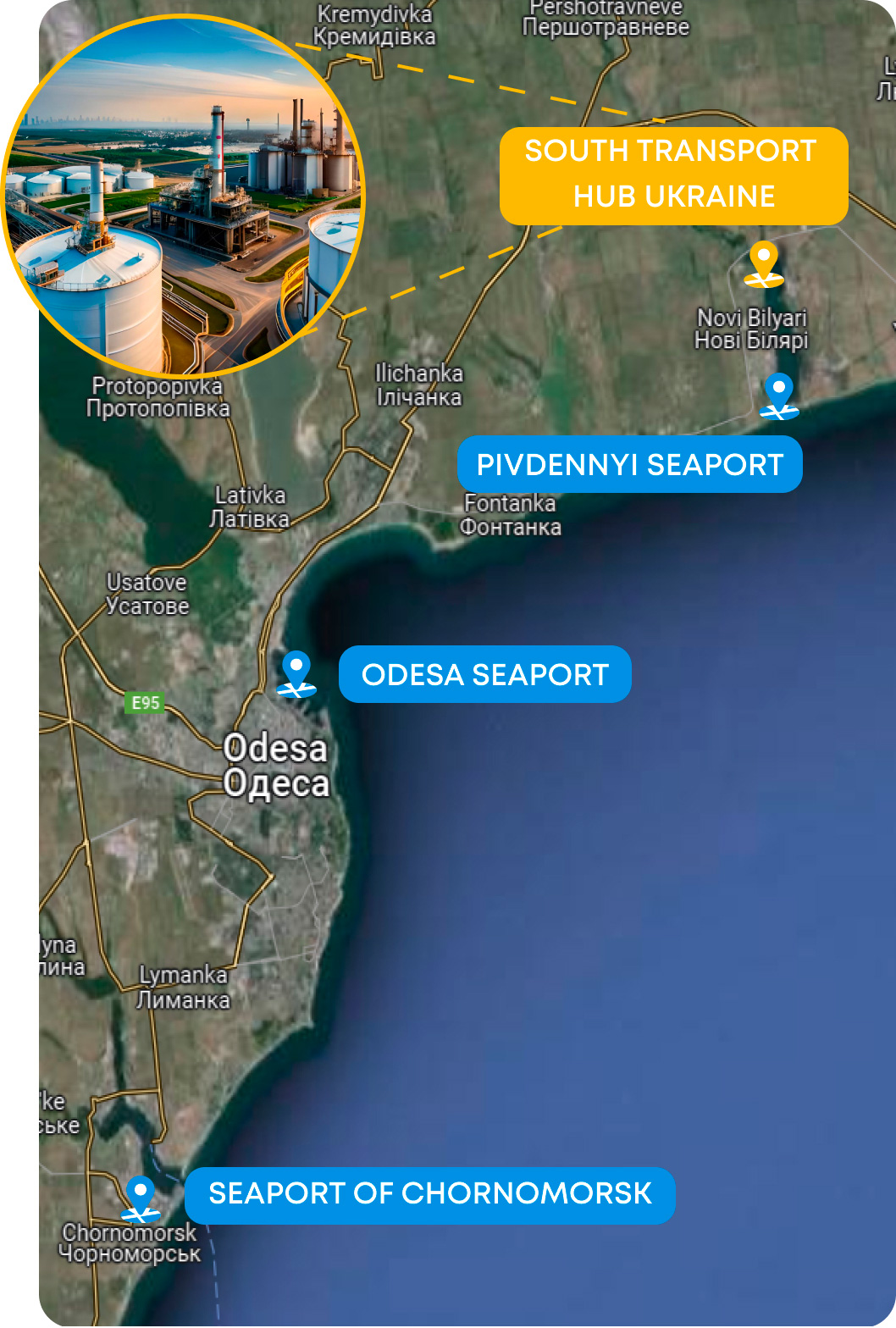
About the South Transport Hub of Ukraine

The existing and planned Infrastructure:

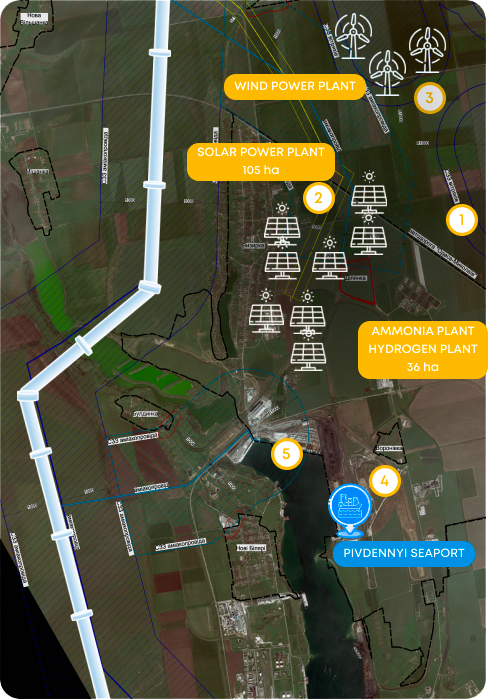
With a vision for growth, the project plans to expand into four strategically chosen locations. These locations encompass a total area of 105 hectares, designated for the deployment of solar PV and wind energy systems. To ensure effective energy storage and grid balancing, the project also incorporates plans for battery storage systems.
01
Green ammonia production capacity:
up to 3 300 mtpd (1 204 500 mtpy)
Electrolyzer capacity:
up to 1485 MW
02
Ammonia and High-Pressure Pipelines
03
Railways Transportation
04
Pivdennyi Seaport
05
Berth24
128 m Depth 13,5 m Ship CH-50
Berth 27 (project)
335 m Depth 15 m Ship CH-100
Berth 27b (project)
128 m Depth 13,5 m Ship CH-50
The Project Concept
1
2
3
4
5
6
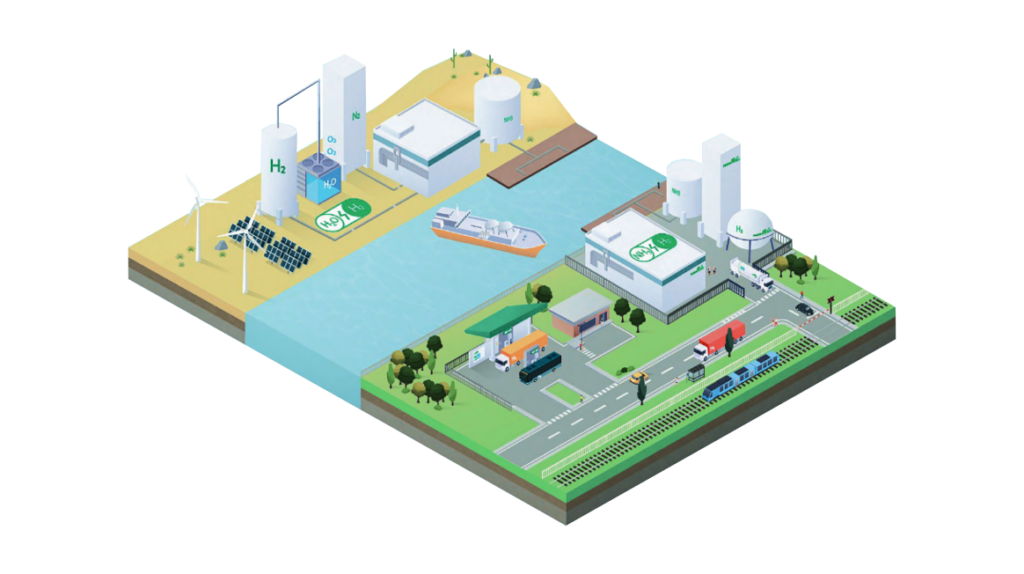
01
Renewable energy Generation and Storage:
Renewables such as solar and wind generate electricity
02
Ammonia and High-Pressure Pipelines:
Renewable electricity splits desalinated water to produce green hydrogen
03
Railways Transportation:
Green nitrogen is combined with the hydrogen to form ammonia, enabling the renewable energy to be transported.
04
Pivdennyi Seaport:
The renewable energy arrives by ship to the Port Pivdennyi, where it is stored.
05
Production Facility
Green hydrogen is produced and conditioned in Pivdennyi, using the stored renewable energy.
06
Usage:
Green hydrogen  and ammonia fuels HGVs, buses, trains, plains and ships incoming to the port.

Route to Market Strategy

Market Expansion Goal
  • Position as a leader in green hydrogen and ammonia in Ukraine.
  • Capitalize on the strategic location near the South Transport Hub to facilitate easy export and global distribution.
  • Leverage existing ammonia pipeline connections and port facilities to enhance export capabilities.
  • Set a precedent in large-scale renewable resource integration in Black Sea region.
Target Customers
  • Chemical and Energy Industries: Serve as a primary supplier to the chemical industry for ammonia applications and energy giants investing in hydrogen for clean power.
  • Transportation Sector: Target maritime and ground transport companies adopting green ammonia as a cleaner alternative to traditional fuels, supporting the global push for decarbonized logistics.
  • Agricultural and Residential Sectors: Provide eco-friendly fertilizers to the agricultural sector and supply green energy solutions to local power suppliers, improving community sustainability and resilience.
Growth Strategy
  • Accelerate profitability through the commercialization of green hydrogen and ammonia.
  • Optimize production costs by integrating and storing renewable energy sources such as solar and wind.
  • Safeguard technological advancements through IP rights and adaptive strategies for global market penetration.
Wider Impact
The EU, along with many other countries, is committed to achieving net-zero emissions by 2050. Hydrogen is a crucial option for reducing emissions in heavy industry and long-haul transport sectors, where limited solutions exist.
Supply Chain Diversification:
Supports multiple sectors, driving decarbonization across technology, agriculture, and transport
Energy Security and Climate Action:
Reduces dependency on energy imports by over 30%, aligns with Ukraine’s goals to cut national CO2 emissions by 5% annually.
Environmental and Economic Advantages:
  • Annual production of 1.2 million tonnes of green ammonia.
  • Reduces carbon emissions by 3.2 million tonnes CO2e each year.
Job Creation and Economic Growth:
  • Generates 500 to 2,500 jobs, significantly enhancing the economic activity in the Odesa region.
  • Capacity building local curricula to support green industry skills.
Infrastructure Expansion:
Mobilization of $100 million investments into modernisation of regional transportation and energy infrastructure. Facilitation of over 20 international joint ventures, fostering technological exchange and economic expansion
The current Ammonia Production In Europe
In the EU-27, 32 ammonia facilities are now operating. Combined, at total capacity, EU-27 plants can produce around 17.7 Mt of ammonia per year*
6.8%
share of the ammonia production at the plant in Ukraine of all ammonia production in Europe
Global ammonia production has been increasing over the past decade, reaching almost 185 Mt in 2021**
Ukraine Hydrogen Valley

Momentum under the Green Deal: The newly developed initiative called RePower EU has increased the EU’s 2030 target to 45% renewables in the EU mix, up from the current target of 40% requiring innovative projects and solutions to achieve the ambitious objectives.

The Black Sea Hydrogen Valley: Represents the renewable energy potential of the south of Ukraine, which, together with the 33 000 km gas transportation infrastructure, will ensure the economically successful export of green ammonia and hydrogen by 2050.

Launch of the Ukraine accession programme to EU: As part of closer cooperation with EU, In February 2023, Ukraine and the EU signed a MOU focusing on Ukranian’s hydrogen production to achieve the goal outlined in the EU strategy of 10 million tonnes of renewable hydrogen imports by 2030.

South Transport Hub Ukraine
The Black Sea can potentially become a hub for hydrogen production.

GLOBAL AMMONIA INFRASTRUCTURE:

SEABORN TERMINALS

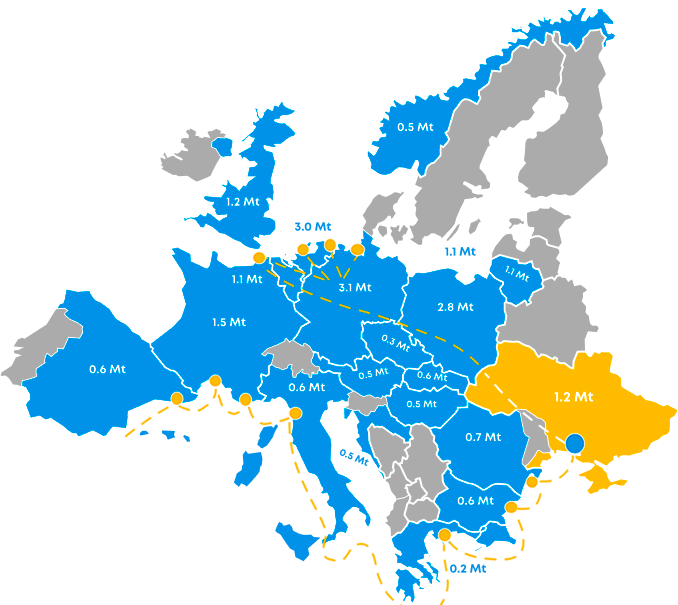
Europe plays a significant role in global ammonia production, accounting for 8-10% of the total, according to IFA, 2021. In the EU-27, there are currently 32 ammonia facilities in operation.

Combined, at total capacity, EU-27 plants can produce around 17.7 Mt of ammonia per year. Moreover, the EU imported just 4mn t/yr of ammonia in 2020, accounting for one-fifth of global trade.

International shipping routes are well-established - 38 ports are now exporting ammonia, while 88 ports are importing it. They are all equipped with isothermal tanks, spherical pressure storages, and unique pipe and valve systems used in a liquid ammonia discharging arm for pumping ammonia in and out of ships.

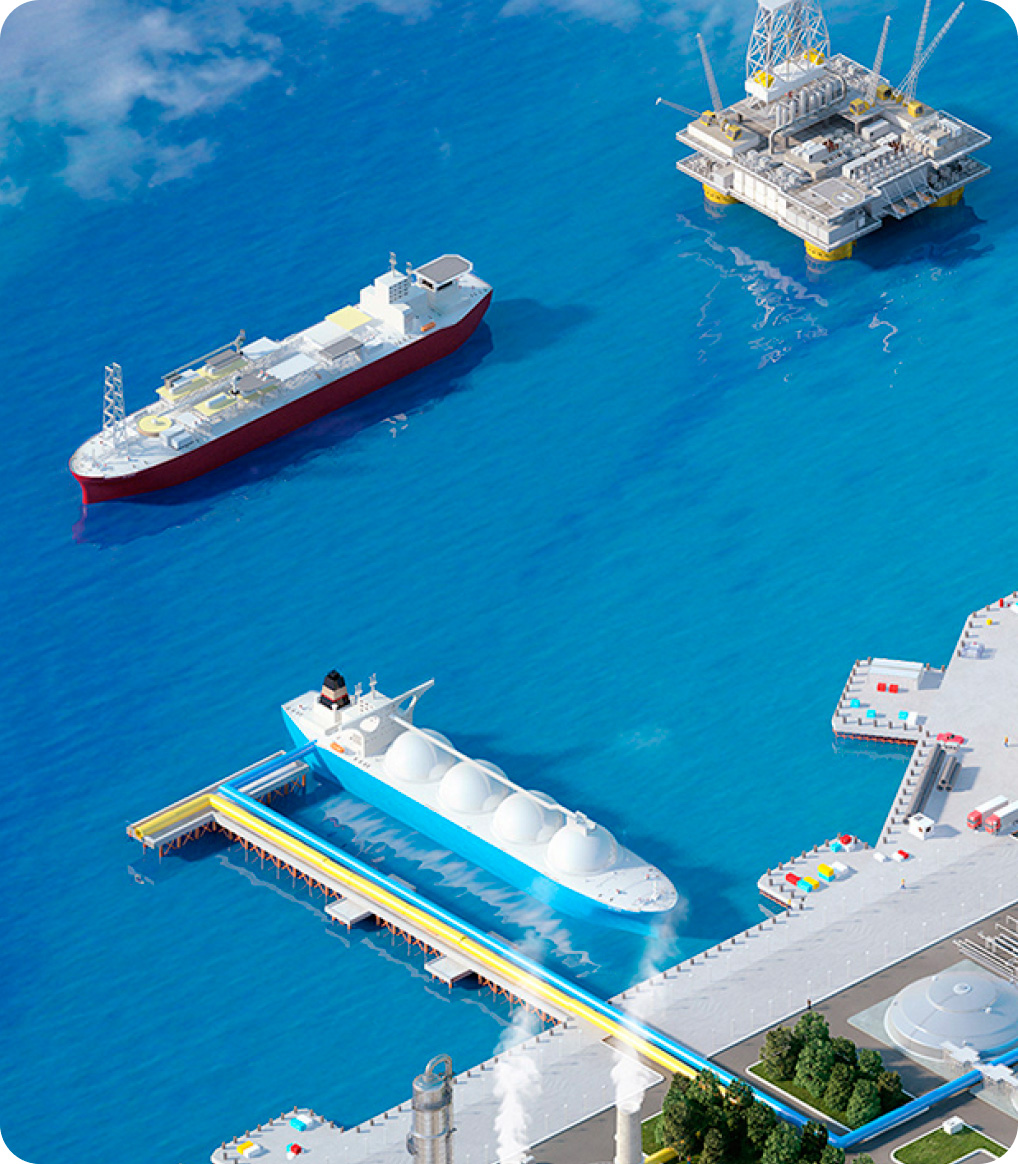
Ammonia, when used as a marine fuel, necessitates the development of accessible infrastructure for bunkering and ship maintenance. Consequently, ports equipped with ammonia terminals are poised to become essential hubs in the distribution network.

Import Terminals/Discharge ports
SOUTH TRANSPORT
HUB/UKRAINE
What Kind of Stakeholders We are Looking for?
We are open to partnerships and cooperation proposals from a wide network of stakeholders who are:
Technology Providers
Research Institutions
Infrastructure Developers
Investors
CONTACT US

Become part of the revolutionary energy hub in the Black See Region

Fill a special form below, and let's get started!